Quick answer
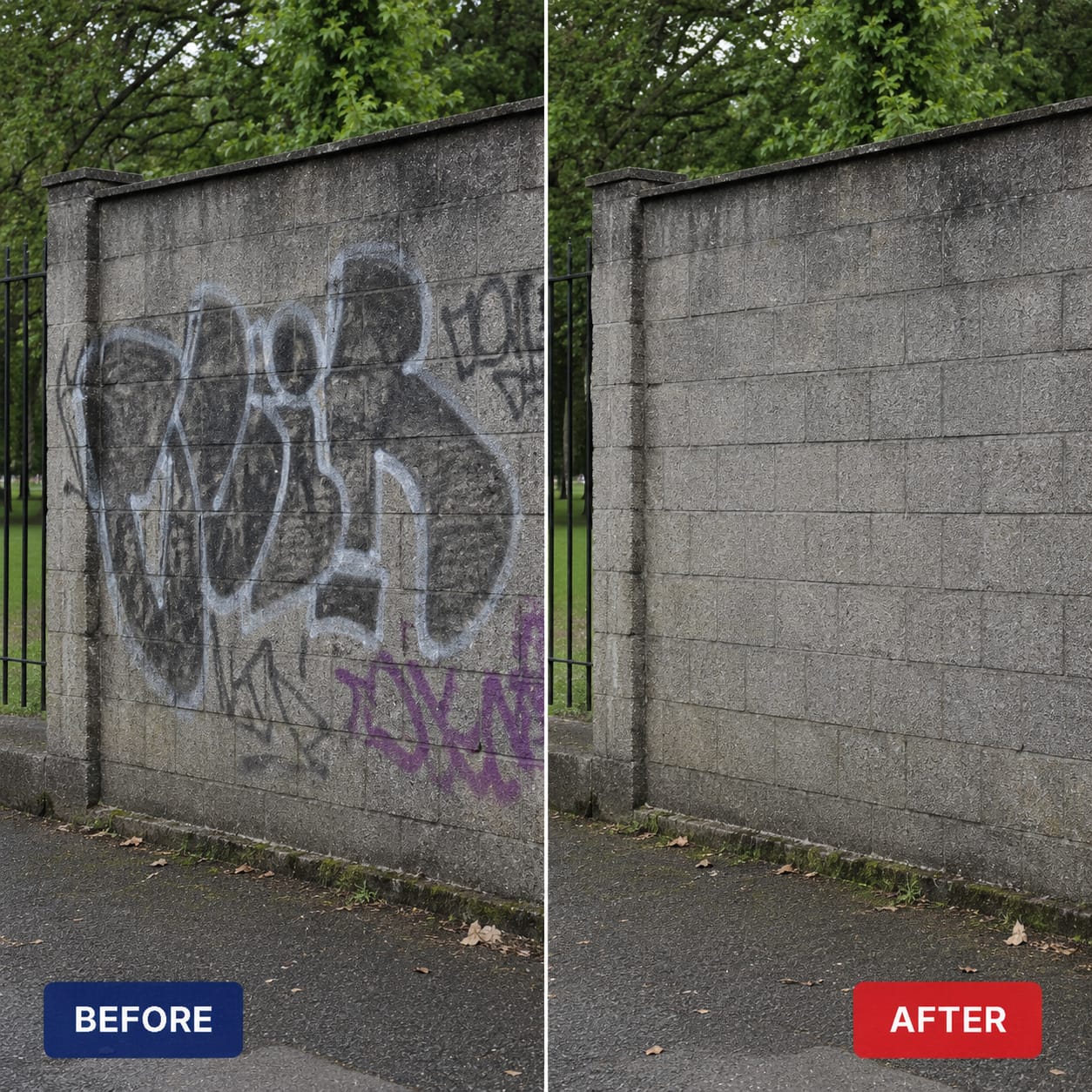
Remove graffiti from sandstone gently. Start with low-pressure steam at around 150°C, which softens paint without eroding the stone. Where paint has soaked into the pores, use a tested specialist remover or poultice. Never use high-pressure washing or blasting. On listed buildings or in conservation areas, talk to the council's conservation team before major cleaning or coating.
Liverpool has more sandstone than most British cities. The local red sandstone, quarried at places such as Woolton, went into the Anglican Cathedral, parish churches, boundary walls and merchants' houses, and paler buff sandstones appear on banks, offices and civic buildings across the city centre. It is beautiful stone, and it is also some of the easiest to damage when graffiti is removed badly.
This guide explains why sandstone needs special care, the methods that work, the ones that cause lasting harm, and what owners of listed buildings and properties in conservation areas should think about before anyone starts cleaning.
Why is sandstone so easy to damage?
Sandstone is made of grains of sand held together by natural cements. Some sandstones are well bound and hard wearing. Many, including a lot of the softer red stone seen around Liverpool, are relatively weak and very porous. Two things follow from that.
First, spray paint does not just sit on the surface. It arrives as a fine mist and wicks into the pores, sometimes several millimetres deep. Second, the surface of the stone is often its strongest part. Over decades, many sandstones develop a slightly harder outer skin. Strip that away with aggressive cleaning and the softer stone underneath weathers faster, holds dirt and can start to crumble.
That is why the wrong method can leave a building in worse condition than the graffiti did. A pale, scoured outline in the exact shape of the tag, often called ghosting, can stay visible for years.
Why you should never pressure wash or blast sandstone
It is tempting to reach for a pressure washer. On sandstone it is usually a mistake. High-pressure water drives paint and water deeper into the stone, cuts into the surface, erodes soft beds and opens up mortar joints. Abrasive blasting is worse, because it removes the face of the stone along with the paint.
Damage like this cannot be undone by cleaning. The only fix is stone repair or replacement, which on a heritage building is slow, expensive and may itself need consent. We do not use media blasting at all, and on sandstone we keep pressure low throughout.
If someone offers to blast graffiti off a sandstone wall, say no. The paint may go, but the face of the stone goes with it, and you can be left with a permanent scar.
Step 1: Assess the stone and the paint
Every job starts with a look at what we are dealing with. Is the stone sound, or already flaking or powdering? Is it a single tag or several layers of paint? How old is the graffiti? Fresh paint is far easier to remove than paint that has had months to cure. Are there previous coatings, repairs or cement pointing that will behave differently from the stone?
We also check what is nearby. Drains, gullies, planting, the docks or the canal all affect which methods are appropriate and how run-off is controlled.
Step 2: Start with low-pressure steam
The first method on sandstone is almost always superheated steam. Systems such as DOFF and ThermaTech heat water to around 150°C at the nozzle but deliver it at very low pressure. The heat softens the paint and breaks its bond with the stone, and a small amount of water carries it away. There is no chemical residue and far less water than a pressure washer, so the stone dries more quickly.
On fresh graffiti, steam on its own often removes everything. Where it does not, it still lifts the surface layer of paint, which means less chemistry is needed in the next step. You can read more about the method on our <a href='/systems/steam-and-hot-water-cleaning/' class='text-brand underline'>steam and hot-water cleaning</a> page.
Step 3: Use poultices and specialist removers where needed
When paint has soaked deep into the pores, heat alone cannot reach it. This is where specialist removers and poultices come in. A remover breaks down the binder in the paint so it can be rinsed out. A poultice is a paste that is applied to the stained area, often covered, and left to draw the pigment out of the stone as it dries.
Products are chosen from a small test patch in a discreet spot, because different paints and different sandstones react differently. Run-off is contained and the area is rinsed with steam afterwards. Our <a href='/systems/chemical-cleaning-and-poultices/' class='text-brand underline'>chemical cleaning and poultices</a> page explains the approach in more detail, and our comparison of <a href='/news/steam-vs-chemical-graffiti-removal/' class='text-brand underline'>steam and chemical graffiti removal</a> covers when each one wins.
- Test patches first, always on a hidden area
- The mildest product that works, not the strongest available
- Several gentle applications rather than one aggressive one
- Containment of run-off, especially near drains and water
- A final steam rinse to leave the stone clean and neutral
Listed buildings and conservation areas
Liverpool has thousands of listed buildings and dozens of conservation areas, from the Georgian Quarter and Castle Street to the Royal Albert Dock. If your building is listed or in a conservation area, the safest course is to speak to the council's conservation team before anything beyond routine, like-for-like cleaning, and especially before applying any coating.
Whether formal consent is needed depends on the building and the work, so it is a question for the local planning authority rather than for a contractor to decide on your behalf. What we can do is supply a method statement, product data and the results of a test patch, which gives the conservation officer something concrete to look at. Historic England also publishes guidance on graffiti on historic buildings, which is worth reading if you manage a heritage property.
Protecting sandstone with a breathable coating
Once a wall is clean, a coating can make the next tag much easier to remove. On sandstone and other historic masonry, the coating must let the stone breathe. Moisture needs to be able to get out of the wall, and a hard, sealing film can trap it, leading to staining and decay.
That is why sacrificial coatings are normally the right choice on heritage stone. They are breathable, nearly invisible and come off with the graffiti under hot water, after which the treated patch is re-applied. Permanent coatings are better suited to modern, non-porous surfaces. Our guide to <a href='/news/sacrificial-vs-permanent-anti-graffiti-coating/' class='text-brand underline'>sacrificial and permanent anti-graffiti coatings</a> goes through the choice, and you can see the products we use on our <a href='/services/anti-graffiti-coatings/' class='text-brand underline'>anti-graffiti coatings</a> page.
What about the rest of the elevation?
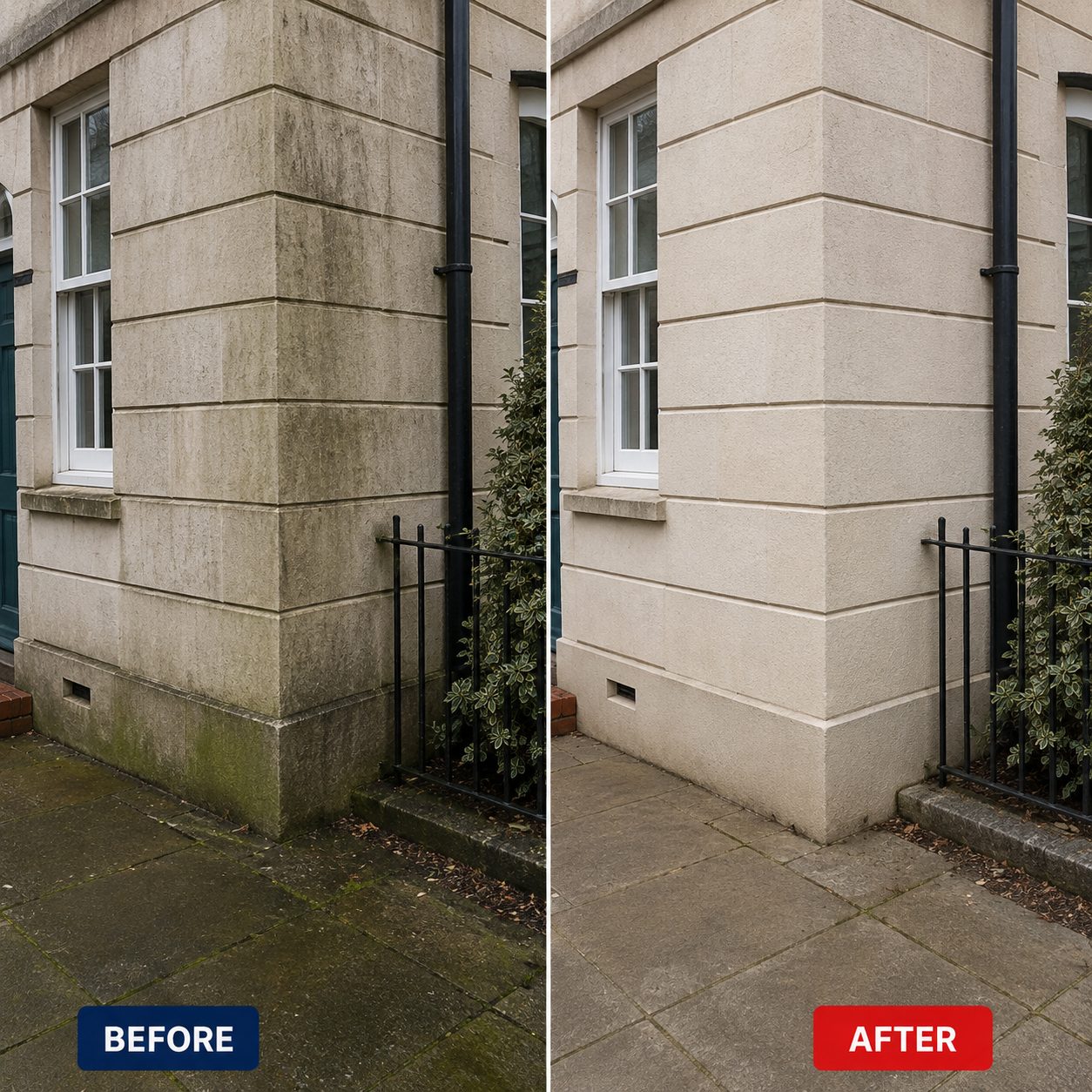
Sometimes removing a tag leaves a patch that is cleaner than the wall around it. On weathered sandstone that difference can be obvious, especially on the darker, sooty facades still seen around Liverpool. In those cases it can make sense to clean a larger, logical area, such as a whole panel between features, so the result blends in.
Full elevation cleaning on sandstone uses the same gentle principles. Our <a href='/services/stone-masonry-cleaning/' class='text-brand underline'>stone and masonry cleaning</a> and <a href='/services/facade-cleaning/' class='text-brand underline'>facade cleaning</a> services cover this, and <a href='/services/moss-algae-lichen-treatment/' class='text-brand underline'>moss, algae and lichen treatment</a> deals with the green growth that often forms on shaded stone.
Frequently asked questions
Can graffiti be removed from sandstone without damage?
In most cases, yes. Low-pressure steam, followed where needed by tested removers or poultices, removes graffiti while keeping the face of the stone intact. Very old or deep paint on porous stone can sometimes leave a faint shadow, which careful repeat treatment usually reduces.
Why can't I just pressure wash graffiti off sandstone?
High pressure erodes soft sandstone, drives paint deeper into the pores and opens mortar joints. It often leaves a scoured outline of the tag that cannot be cleaned away.
Do I need permission to remove graffiti from a listed building in Liverpool?
It depends on the building and the method. Speak to Liverpool City Council's conservation team before anything beyond routine cleaning, and before applying any coating. A method statement and test patch results help that conversation.
Which anti-graffiti coating is best for sandstone?
A breathable sacrificial coating is usually the right choice for sandstone and other historic masonry. Permanent coatings can trap moisture in porous stone, so they are better kept for modern, non-porous surfaces.
Graffiti on a sandstone or heritage building in Liverpool?
Send us a photo and the address. We will tell you the gentlest method that will work and give you a free quote. Or call 0161 399 5247.