
Graffiti Removal & Exterior Cleaning in Liverpool
No Graffiti Ltd removes graffiti and cleans building exteriors across Liverpool, from Liverpool ONE, Bold Street and the Baltic Triangle to Anfield, Wavertree and Speke. We work for councils, BIDs, housing providers, universities, managing agents and shop owners, with sandstone-safe methods, anti-graffiti coatings and same-day response to every enquiry. Send a photo or call 0161 399 5247 for a free quote.
Liverpool Districts Where We Remove Graffiti and Clean Exteriors
We work right across the city covered by Liverpool City Council, from the waterfront and city centre out to the northern and southern suburbs, including:
- City Centre
- Baltic Triangle
- Georgian Quarter
- Toxteth
- Anfield
- Everton
- Walton
- West Derby
- Wavertree
- Aigburth
- Woolton
- Speke

No Graffiti Ltd is a specialist graffiti removal and exterior cleaning company working across Liverpool. We take tags off sandstone, brick, shutters and street furniture, wash down paving and car parks, strip gum and fly-posting, and apply anti-graffiti coatings to the walls that keep getting hit. We have been doing this since 2001, on more than 10,000 projects, and every enquiry gets a response the same day. To get a price, send a photo and a postcode, or call 0161 399 5247.
Liverpool is one of the most rewarding and demanding cities we work in. In a single morning you can move from red sandstone churches and Georgian terraces to dockside warehouses, steel roller shutters on a busy retail street and concrete underpasses on the edge of the city centre. Each of those surfaces needs a different approach, and getting it wrong on soft stone or a heritage frontage can leave a mark that outlasts the graffiti. That is why we match the method to the surface on every job, rather than turning up with a pressure washer and hoping for the best.
City centre retail: Liverpool ONE, Church Street, Lord Street and Bold Street
The retail core is where appearance matters most and where graffiti does most commercial damage. Liverpool ONE, Church Street and Lord Street carry huge footfall, and Bold Street's independent shops, cafés and restaurants trade on how their frontages look. A tagged shutter or a stickered window on a street like that tells every passer by the area is not being looked after.
Most of the city centre falls within the business improvement districts run by Liverpool BID Company, including the Retail & Leisure BID, which takes in streets such as Bold Street, Church Street and Lord Street, and the Culture & Commerce BID covering the commercial district, waterfront and St George's Quarter. We are used to working alongside business improvement districts and individual occupiers, so a shop owner, a landlord and a BID can all be dealt with sensibly on the same street.
In the city centre, timing is everything. We plan work for early mornings, evenings and quieter days so that shutters and shopfronts are clear before doors open. The same visit can usually take in chewing gum removal from the entrance paving and fly-posting and sticker removal from glazing, signage and service doors, because a clean wall above a gum-spotted pavement still looks neglected.
- Painted and powder-coated roller shutters cleaned without stripping the finish
- Stickers and paste-ups taken off glass, metal and stone without scratching or ghosting
- Gum and staining lifted from paving, entrances and pedestrianised routes
- Shopfront fascias, stallrisers and pilasters cleaned to match the rest of the frontage
- Work booked around trading hours, deliveries and busy weekends
Tags on your Liverpool shopfront or shutter?
Send a photo and the street name. We respond the same day and can book city centre work before you open.
Baltic Triangle and Ropewalks: protecting street art, removing tags
Liverpool has a real street art culture, and the Baltic Triangle is at the heart of it. Walls around Jamaica Street and Jordan Street carry large commissioned murals, including the well-known Jürgen Klopp piece, and new work appears all the time. Ropewalks, between Bold Street and Duke Street, has its own mix of creative businesses, bars and painted walls. Not everything with spray paint on it is graffiti, and we treat it that way.
The difference is permission. A mural painted with the owner's agreement is part of the building. A tag sprayed across it, or across the clean wall next to it, is vandalism, and it is often what makes a good piece look scruffy. We regularly take tags off around murals without touching the artwork, and we can protect a finished mural so the next tag is easier to deal with.
- We confirm with the building owner what is commissioned and what should stay before any work starts
- Tags next to a mural are cleared using low-pressure steam and hot water with masking along the edge of the artwork
- Tags on top of a mural are tested on a small hidden area first, because the same product can affect both layers of paint
- Where a mural is tagged repeatedly, a clear sacrificial anti-graffiti coating can be applied over it, with the artist's or owner's agreement
- Fresh tags are removed quickly, because a tagged wall attracts more tagging
If you own a building with a commissioned mural, keep a dated photo of it and a note of who painted it. It makes it quicker to agree what stays and what goes when tags appear, and it helps if you ever need to report the damage.
Sandstone, Georgian terraces and heritage buildings
Liverpool is built on sandstone, literally. The local red sandstone, quarried at places like Woolton, went into the Anglican Cathedral, churches, walls and merchants' houses across the city, and you will find paler buff sandstones, granite and Portland stone on many of the grander commercial and civic buildings. Sandstone is soft and porous. Spray paint soaks into it, and aggressive cleaning tears the surface away, so the method matters more here than almost anywhere else.
Our approach on stone is always gentlest first. We start with superheated steam from DOFF and ThermaTech systems, at around 150°C but very low pressure, which softens paint without eroding the face. Where paint has gone deep into the pores, we use specialist removers and poultices that draw it back out, chosen from a test patch. We never use high-pressure blasting on sandstone. More detail is in our guide to removing graffiti from sandstone and heritage buildings in Liverpool.
The Georgian Quarter around Rodney Street, Canning Street and Hope Street is mostly brick with stone dressings, railings and painted doorcases, and much of it sits in conservation areas. Liverpool City Council says the city has more than 30 conservation areas, and many buildings within and beyond them are listed. If your building is listed or in a conservation area, it is sensible to talk to the council's conservation team before anything beyond routine cleaning, and particularly before applying a coating. We are happy to provide method statements and test results to support that conversation. For full elevations, our stone and masonry cleaning and facade cleaning services use the same careful approach.
The waterfront, the docks and the canal
From the Pier Head and the Three Graces to the Royal Albert Dock, the waterfront is Liverpool's most photographed stretch of the city, and it has some of the most sensitive surfaces too. The Royal Albert Dock is the largest group of Grade I listed buildings in the country, built of brick, stone and cast iron. Around the docks you will also find modern apartment blocks, hotels, offices, car parks and public seating, all of which pick up graffiti, bird fouling and weathering in the salty river air.
Water is the big consideration. The Leeds and Liverpool Canal now runs past the Pier Head through the Liverpool Canal Link, and the docks and the Mersey are never far away. Near open water we favour chemical-free methods and contain run-off wherever chemistry is needed. Our bird fouling removal and street furniture cleaning services suit waterfront estates, and moss, algae and lichen treatment deals with the green growth that builds up on shaded, damp elevations.
Universities, the Knowledge Quarter and hospitals
Liverpool's Knowledge Quarter brings together the University of Liverpool, Liverpool John Moores University, the Royal Liverpool University Hospital and research institutions across the eastern side of the city centre, and Liverpool Hope University has campuses in Childwall and Everton. Campuses mix Victorian red brick, listed buildings and big modern blocks, with student footfall day and night. Graffiti, stickers and gum appear quickly, and estates teams want them gone without disrupting teaching, research or patients.
We work for universities and colleges and healthcare sites to agreed schedules, with steam cleaning where chemical residue would be a problem near entrances, play areas or clinical buildings. Planned rounds work well here, because the same hot spots tend to be hit term after term.
Housing estates, landlords and housing associations
Across Anfield, Everton, Walton, Kirkdale, Toxteth, Norris Green and Speke, the graffiti we see on residential estates is different from the city centre: garage courts, gable ends, bin stores, communal entrances, stairwells and boundary walls. Residents notice it straight away, and offensive or threatening graffiti needs to go the same day where possible. We prioritise it.
We work for housing associations, managing agents and private landlords on call-off arrangements and fixed rounds. A typical visit might combine tag removal with pressure washing of paths and bin areas and a coating on the gable that gets hit every month. Brick, render, render and cladding and painted surfaces each get the right method, and offensive graffiti is always treated as urgent.
Managing Liverpool estates or several sites?
We can put your properties on one planned round with agreed response times and one point of contact.
Merseyrail stations, bridges and underpasses
Transport infrastructure attracts graffiti because it is visible and often quiet at night. Liverpool's Merseyrail network runs underground through Lime Street, Central, Moorfields and James Street, and out across the city on the Northern and Wirral lines, with bridges, retaining walls, ramps and station approaches along the way. Add the subways and pedestrian underpasses near the city centre ring road and the inner suburbs, and there is plenty of concrete and brick to keep clean.
We work for transport operators and councils on subway and underpass cleaning, taking care of lighting, drainage and public safety while we work. Where access is the problem, our specialist access team handles height and restricted space properly.
Commercial, industrial and retail parks
Business parks and industrial estates get a different kind of attention: tags on cladding and palisade fencing, oil and tyre marks across yards, weeds and moss in block paving, and dirty car parks that undermine an otherwise smart building. In Liverpool that includes the estates around Speke and Garston near the airport and Wavertree Technology Park, and just over the boundary, Knowsley Industrial Park at Kirkby and the sites around Aintree.
Our industrial pressure washing, forecourt and yard cleaning and car park cleaning services are built for this kind of site, and commercial exterior cleaning brings the whole building, signage and entrance up to the same standard. For retail and business parks, we work around opening hours and traffic, and can include graffiti response in a planned contract.
Why it pays to act fast in Liverpool
Graffiti that stays up attracts more graffiti. One tag on a clean wall becomes three within weeks, and once a spot is on the circuit it is far harder to keep clear. Quick removal breaks that cycle and costs less, because fresh paint lifts more easily than paint that has had months to cure into the surface.
Councils can also act on graffiti that harms an area, including through community protection notices, so leaving it is rarely the cheap option. Our emergency graffiti removal service covers anything offensive, racist or threatening, and our planned maintenance contracts keep regular sites under control without you having to report every tag.
How we work across the Liverpool City Region
Our vans are based in Macclesfield, Cheshire, and Liverpool is a regular part of our working week. We schedule Liverpool work properly, grouping jobs so that city centre, suburban and waterfront sites can be handled in planned visits, while urgent and offensive graffiti is prioritised. We are open seven days a week, fully insured and CHAS accredited, and we supply RAMS and COSHH assessments as standard.
Many of our clients hold property in more than one borough, so we cover the whole city region and its neighbours on the same schedule: Wirral across the Mersey, Sefton to the north, Knowsley and St Helens to the east, Halton to the south east and Warrington beyond. We also work for councils, commercial property owners and facilities management companies whose portfolios cross these boundaries.
Liverpool graffiti removal prices
Every job is priced on what it actually involves. There is a mobilisation, or call-out, fee of around £200 plus VAT, depending on where the site is, and the treatment is priced on top. The treatment cost depends on the surface, how much paint there is, how long it has been there, access and whether a coating is worthwhile. Regular contract customers pay less, because planned visits are more efficient.
Photos and a postcode are usually enough for a firm quote. For multi-site portfolios we will look at the sites and propose a schedule. Our guide to graffiti removal costs explains what drives the price, and our main graffiti removal page covers every method we use. When you are ready, get in touch or call 0161 399 5247.
Get graffiti removed in Liverpool
Same-day response to every enquiry, sandstone-safe methods and planned schedules across the city region. Fully insured and CHAS accredited.
More than graffiti in Liverpool
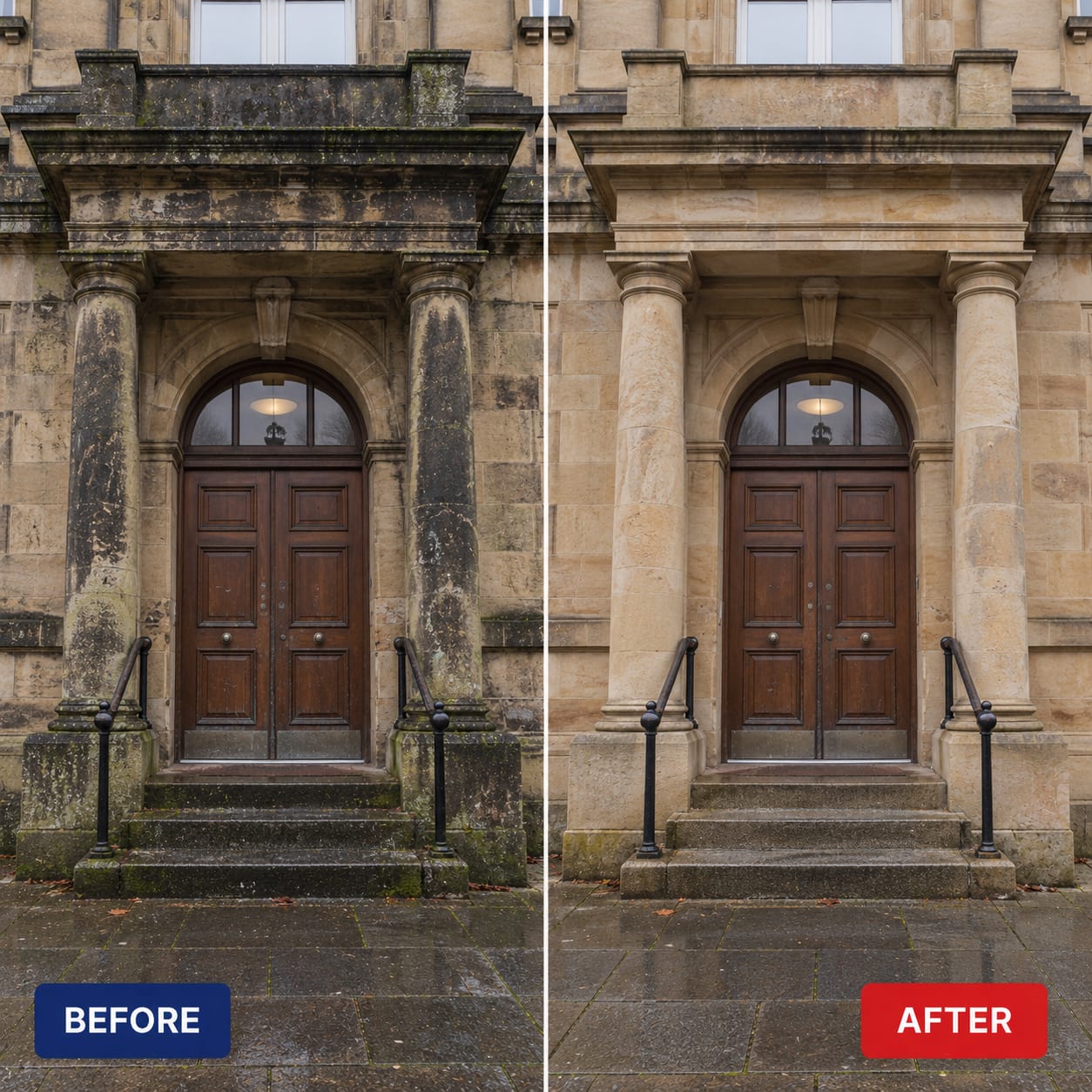
The same crews and equipment handle the rest of the outside of a building. In Liverpool that means facades, paving, steps, cladding, yards and play areas as well as walls and shutters, so one contractor can keep a whole site presentable.
See our stone and masonry cleaning serviceOur Services in Liverpool
In Liverpool we take on far more than tags. Our services cover graffiti, gum, fly-posting, moss and grime on everything from red sandstone and Georgian brick to shutters, car parks and industrial cladding, plus protective coatings for the walls that keep getting hit.
Graffiti Removal
Anti-Graffiti Coatings
Commercial Pressure Washing
Commercial Chewing Gum Removal
Playground Cleaning
Street & Public Realm Cleaning
Stone & Masonry Cleaning
Fly-Posting & Sticker Removal
Planned Maintenance
Moss, Algae & Lichen Treatment
Sign & Street Furniture Cleaning
Subway & Underpass Cleaning
Shutter & Shopfront Cleaning
Commercial Car Park Cleaning
Bird Fouling Removal
Commercial Façade Cleaning
Paint Removal
Emergency Graffiti Removal
Offensive Graffiti Removal
Commercial Exterior Cleaning
Industrial Pressure Washing
Forecourt & Yard Cleaning
Render & Cladding Cleaning
Retail & Business Park Cleaning
Who We Help in Liverpool
Councils & public bodies
Rapid response and planned cleaning to keep Liverpool's public realm clean and welcoming.
Housing providers
Fast, tenant-friendly removal from communal areas, blocks and estates across Liverpool.
Businesses & landlords
Graffiti removal, shopfront and shutter cleaning, gum removal and coatings for Liverpool retailers, venues, offices and landlords, scheduled around trading hours.
Liverpool Graffiti Removal FAQs
Do you provide graffiti removal in Liverpool?
Yes. We work across Liverpool regularly, from the city centre, Baltic Triangle and Georgian Quarter to Anfield, Walton, Wavertree, Woolton and Speke. Our vans are based in Macclesfield, Cheshire, and we schedule Liverpool work on a regular basis. Every enquiry gets a same-day response, and offensive graffiti is prioritised for removal as quickly as possible.
Can you remove tags without damaging street art or a commissioned mural?
Usually, yes. Tags sprayed next to or across a mural are removed with careful, small-area methods such as low-pressure steam and hand-applied removers, tested first on a hidden spot. Where a tag sits directly on top of the mural, we agree the approach with the building owner beforehand, because the mural paint and the tag can react to the same products.
Is it safe to remove graffiti from Liverpool sandstone?
It is when the method suits the stone. Liverpool's red and buff sandstones are soft and porous, so we start with low-pressure steam at around 150°C, then use poultices or specialist removers only where paint has soaked in. We never blast sandstone with high pressure, because that erodes the face and can leave a permanent outline of the tag.
Can you clean city centre properties out of hours?
Yes. We are open seven days a week and regularly plan city centre work for early mornings, evenings or quieter days, so shopfronts on streets like Bold Street, Church Street and Lord Street can be cleared before trading starts. Out-of-hours work is agreed in advance with the site and booked into our Liverpool schedule.
Do you work for Liverpool City Council, BIDs and public bodies?
We work with councils, business improvement districts, housing providers, transport operators and facilities teams, and we are set up for public sector paperwork. That means CHAS accreditation, full insurance, RAMS, COSHH assessments and controls on run-off. We can work to a planned round across several sites or respond to individual reports.
How much does graffiti removal cost in Liverpool?
There is a mobilisation, or call-out, fee of around £200 plus VAT, depending on where the site is, and the treatment is priced on top. The treatment price depends on the surface, the amount of paint, access and whether a coating is added. Regular contract customers pay less. Send photos and a postcode for a firm quote.
Should I put an anti-graffiti coating on my Liverpool building?
If the same wall keeps getting tagged, a coating usually saves money. Sacrificial coatings are breathable and suit sandstone, older brick and heritage buildings. Permanent coatings suit modern surfaces such as metal, shutters and smooth render that are hit often. On listed buildings or in conservation areas, we recommend checking with the council's conservation team first.
Do you cover the rest of the Liverpool City Region?
Yes. Alongside Liverpool we work in Wirral, Sefton, Knowsley, St Helens and Halton, and in Warrington next door. Organisations with sites in more than one borough can have them all on one schedule, with one point of contact and one set of paperwork, rather than juggling several contractors.
Nearby Areas We Cover
Need graffiti gone fast?
Call 0161 399 5247 or request a free quote. We respond the same day.