Quick answer
The difference is permission. A mural painted with the property owner's consent is street art, and the owner decides whether it stays. Paint applied without consent is graffiti, and the owner is normally responsible for removing it from their property. Tags on or beside a mural can usually be removed carefully, with low-pressure steam and testing, without harming the artwork.
Walk through the Baltic Triangle, along Jamaica Street and Jordan Street, or around Ropewalks and you will see some of the best street art in the North West, from large commissioned murals to smaller painted pieces on shutters and side walls. Walk a little further and you will also see tags, scrawls and stickers on shopfronts, doors and walls that nobody asked for.
For a property owner or business, the question is practical. What can you remove, what should you keep, who is responsible, and how do you get rid of tags without damaging a mural you are proud of? This guide sets out the general position and the methods we use. It is not legal advice, and if you are in a dispute you should take proper advice.
What is the difference between street art and graffiti?
There is no difference in the paint. The difference is permission. A mural painted with the agreement of the building owner is, in effect, part of the building's decoration. The owner chose it and can decide whether it stays, is repainted or is removed.
Paint, marker or stickers applied without the owner's consent are graffiti, whatever their artistic quality. Spraying someone else's property without permission can amount to criminal damage. So the first question on any wall is not "is it good?" but "did the owner agree to it?"
- Commissioned mural: painted with the owner's consent, often with a written agreement with the artist
- Permitted wall: an owner has allowed artists to paint, sometimes on a rolling basis
- Tag: a quick signature or name sprayed or written without permission, usually the most common type
- Unauthorised piece: a larger painting done without consent, even if it looks good
- Fly-posting and stickers: posters and stickers put up without permission
Who is responsible for removing graffiti in Liverpool?
In general, the owner of a surface is responsible for keeping it clean. Many councils remove graffiti from their own property, such as highways, street furniture and council buildings, and some offer services on private property, but that varies and changes over time. If graffiti is on your shopfront, your wall or your shutter, you should normally expect to deal with it yourself or through your landlord, depending on what your lease says.
Councils also have powers where graffiti is harming an area. Under the Anti-social Behaviour, Crime and Policing Act 2014, councils can issue community protection notices where someone's conduct, including a failure to deal with a problem on their property, is having a persistent, unreasonable and detrimental effect on the local community. The older graffiti removal notices under the Anti-social Behaviour Act 2003 were repealed in 2014. In practice, prompt removal means you are unlikely ever to get near that point.
If you are in the city centre, it is also worth knowing that Liverpool BID Company runs business improvement districts covering the main retail, commercial and waterfront areas. If your premises are in a BID area, it is worth asking what support they offer on street cleanliness.
Before removing anything that looks like it might be a commissioned piece, check with the building owner or landlord. A quick question saves an awkward conversation with an artist, a neighbour or a client.
How to protect a mural you want to keep
A mural represents money, time and often goodwill with the local community. Protecting it is simple, and it makes dealing with tags far easier.
The usual approach is a clear sacrificial <a href='/services/anti-graffiti-coatings/' class='text-brand underline'>anti-graffiti coating</a> applied over the finished mural, once the paint has fully cured. If someone tags over it, the tag and the coating come off together with hot water, leaving the mural underneath intact. The coated patch is then re-applied. Some permanent coatings are designed for painted surfaces too, but they can change the sheen, so we test first and agree the finish with the owner and, where possible, the artist.
- Get the owner's agreement, and ideally the artist's, before coating
- Let the mural cure fully before anything is applied
- Test the coating on a small corner to check the colours and finish
- Keep a dated photo of the finished mural for your records
- Arrange for fresh tags to be removed quickly, before others join them
How to remove tags next to a mural
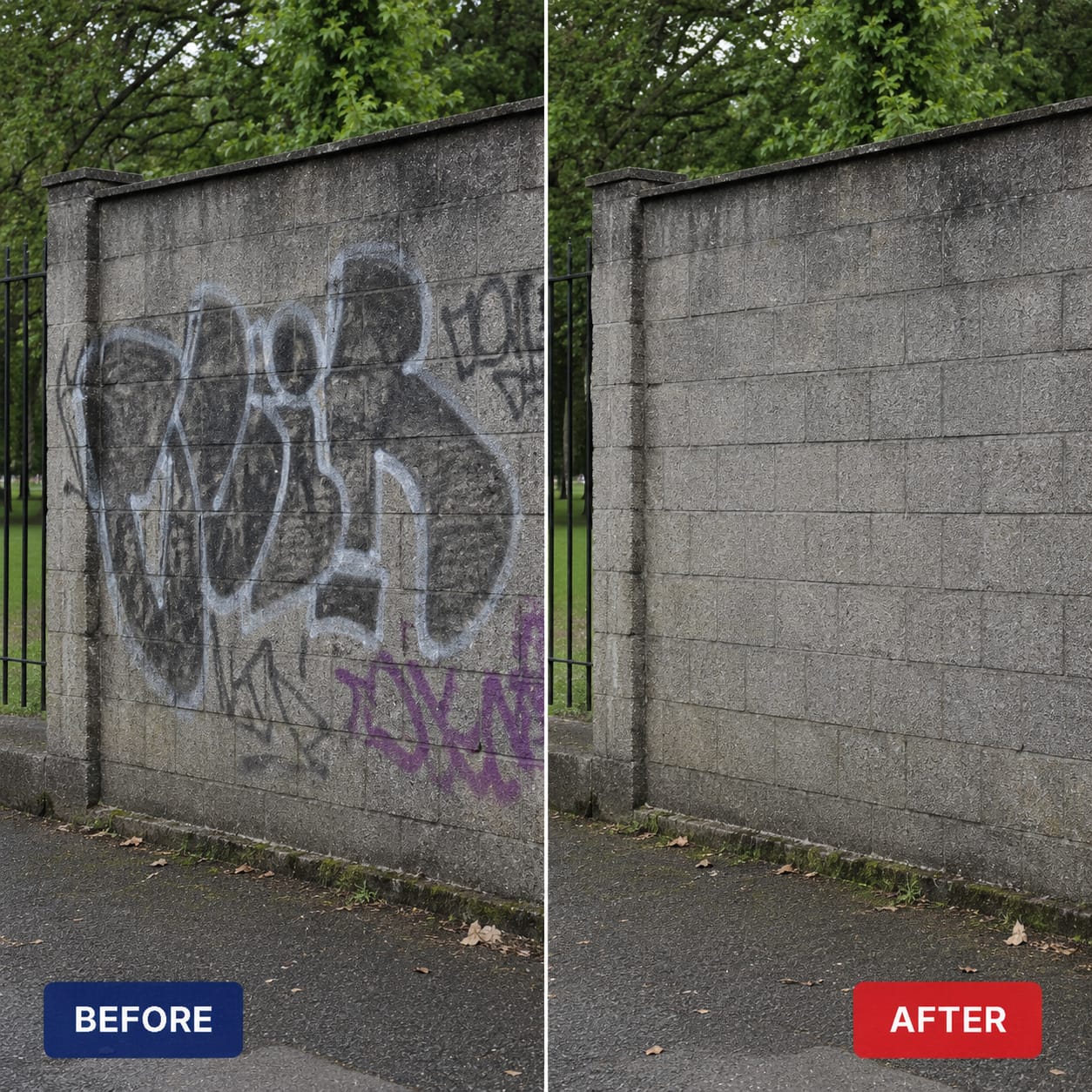
Most of the tags we remove in areas like the Baltic Triangle are on the bare wall, door or shutter beside a mural, not on the artwork itself. Here the job is to clear the tag without the cleaning spreading onto the mural.
We mask the edge of the artwork and use low-pressure <a href='/systems/steam-and-hot-water-cleaning/' class='text-brand underline'>steam and hot water</a>, which lets us work precisely without over-spray. On brick and stone we match the method to the surface, and on shutters and metal doors we use products that will not dull the finish. Our <a href='/services/shutter-shopfront-cleaning/' class='text-brand underline'>shutter and shopfront cleaning</a> and <a href='/services/fly-posting-sticker-removal/' class='text-brand underline'>fly-posting and sticker removal</a> services cover the usual mix of problems on a street frontage.
How to remove a tag that is on top of a mural
This is the delicate one. A tag sprayed over a mural is paint on paint, so a product strong enough to remove the tag can also soften the mural. If the mural was coated, it is straightforward: the tag comes off with the sacrificial coating. If it was not, we work slowly.
We test on a small, hidden part of the tag first, starting with the mildest method. Sometimes the tag paint and the mural paint are different enough that it can be lifted cleanly. Sometimes the honest answer is that some touching up by the artist will be needed afterwards, and we tell you that before starting. We agree the approach with the owner every time.
When removal is the right answer
Not every painted wall needs keeping. Offensive, racist or threatening graffiti should be removed as quickly as possible, whatever its style. Our <a href='/services/offensive-graffiti-removal/' class='text-brand underline'>offensive graffiti removal</a> service prioritises these jobs. Old murals that have faded, been heavily tagged or no longer fit the building can also be removed at the owner's choice, using our <a href='/services/paint-removal/' class='text-brand underline'>paint removal</a> methods.
For walls that keep being tagged and have no artwork, the answer is usually prompt <a href='/services/graffiti-removal/' class='text-brand underline'>graffiti removal</a> followed by a coating, plus a <a href='/services/planned-maintenance/' class='text-brand underline'>planned maintenance</a> visit so new tags never get the chance to build up.
Frequently asked questions
Is street art legal in Liverpool?
Street art is legal when the property owner has given permission. Painting on someone else's property without consent can be criminal damage, however good it looks.
Am I responsible for removing graffiti from my building?
Generally, the owner of a surface is responsible for keeping it clean, and your lease may pass that to you as a tenant. Councils can take action where graffiti is harming an area, so quick removal is the best approach.
Can you remove a tag from a mural without damaging it?
Often, yes, especially if the mural has a sacrificial coating. Without one, we test on a small area first, start with the mildest method and agree the approach with the owner before going further.
How do I protect a new mural from graffiti?
Once the paint has cured, apply a clear sacrificial anti-graffiti coating, tested first on a corner. Tags then come off with hot water, taking the coating with them, and the patch is re-coated.
Tags on or near a mural in Liverpool?
Send us a photo and the location. We will tell you what can safely come off and how to protect what you want to keep. Or call 0161 399 5247.